Exodus is cutting a quarter of its workforce to turn a wallet business into stablecoin payments infrastructure
Exodus has tied a 25% workforce reduction to a broader push into card issuance and stablecoin-linked payments infrastructure. The move matters because it shows a public crypto company trying to convert wallet distribution into a fuller operating stack for onchain money movement.
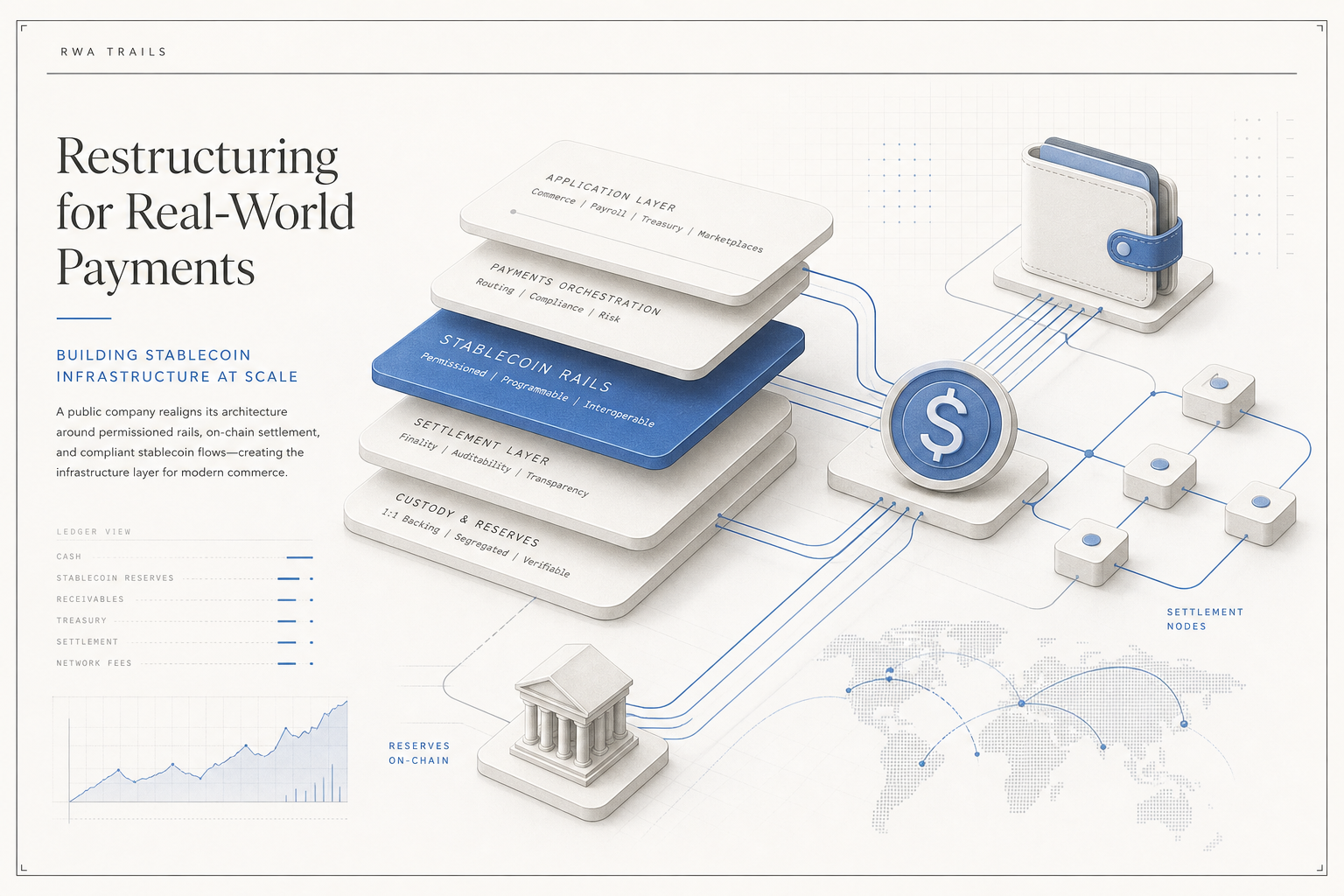
Exodus is no longer presenting itself only as a self-custody wallet company with adjacent payments ambitions. Its latest restructuring makes clear that management is trying to redirect the business toward a more operational role in digital money. In a July 20 filing, the company said it will reduce its global workforce by roughly one quarter as it realigns resources around payments, a move that puts stablecoin utility, card infrastructure and transaction rails much closer to the center of the story than consumer wallet growth alone. For the RWA market, that matters because tokenized assets need usable cash rails, not just issuance and trading venues.
The immediate numbers are material. Exodus said the reduction is expected to affect about 77 employees and individual service providers, representing approximately 25% of its total global workforce. The company estimated restructuring costs of roughly $2.5 million to $3.5 million, mostly tied to compensation, severance and related benefits, with most cash payments expected over the next 12 weeks. It said the process should be completed in the fourth quarter of 2026. Those details frame this as a deliberate operating reset rather than a minor efficiency pass.
The companion company statement gives the strategic reason more clearly. Exodus said the cuts are meant to align its cost base with a plan to build an end-to-end card issuance and payments stack while it continues integrating Monavate and Baanx. Management also said the action should produce about $10 million to $13 million in annualized cash operating savings, with the full benefit showing up in 2027. That combination is important: the company is not simply shrinking to protect margins in a soft market. It is trying to free capital and management attention for a different business mix, one built around moving money and servicing payment flows rather than primarily monetizing wallet activity.
The acquisition trail shows why this pivot deserves attention. In a May 1 filing, Exodus disclosed that it had acquired the outstanding shares of Monavate Holdings and Baanx.com from court-appointed receivers for $76.27 million, the exact amount then outstanding on related loans. The same filing also described a separate $30 million transaction for Baanx US and certain related assets, payable over several years. That matters because Monavate is an electronic money institution and Baanx has focused on crypto-linked payments and card programs. Taken together, those assets give Exodus regulated payments plumbing, issuing capabilities and a larger international footprint that a wallet company would not otherwise have built organically.
Monavate's own announcement after the deal pointed in the same direction. It described the combination as a way to accelerate global payments infrastructure for a market where programmable money and stablecoin-based flows are becoming more commercially relevant. That is a useful corroborating signal because it comes from the acquired payments side of the stack, not only from Exodus management or market commentary. In other words, the integration story is not just about cost takeout after an acquisition binge. It is about combining self-custody distribution with regulated payment rails that can support card issuance, treasury movement and cross-border settlement products.
There is still real execution risk. Building a coherent payments platform out of acquired entities is operationally harder than buying the pieces. Exodus has to integrate teams, licensing processes, compliance controls, card economics and product workflows while it is also reducing headcount. It also has to prove that stablecoin-linked payments can become a durable revenue engine rather than an attractive narrative for public markets. A lower cost base may help, but it does not remove the difficulty of turning separate wallet, payments and infrastructure assets into one reliable platform for institutional and consumer use.
Even so, the move is strategically relevant for RWA watchers because payments infrastructure is one of the missing links between tokenized assets and everyday financial behavior. Tokenized funds, deposits and yield products are more valuable when users can move into spendable digital cash, settle obligations quickly and connect those balances to cards or regulated payment programs. Exodus is effectively betting that the next layer of value in crypto finance will come from operating that connective tissue. That thesis sits closer to the real needs of tokenized markets than another cycle of wallet feature expansion or trading-driven growth.
The near-term question is whether Exodus can turn this reset into measurable payment volume, issuer relationships and stablecoin-linked utility before the restructuring story overwhelms the product story. But the company has now made the strategic direction explicit in public filings: it wants to be part of the infrastructure layer that makes digital dollars and related payment instruments usable at scale. If that bet works, Exodus will look less like a wallet company that added payments and more like a payments company that uses crypto distribution to acquire flow.