Exodus Pushes Tokenized Public Markets Into the Wallet Layer With Ondo-Powered Solana Launch
Exodus has added more than 200 tokenized stocks, ETFs, and other market instruments to its wallet app through an Ondo-powered launch on Solana. The rollout matters because it turns tokenized market access into a native wallet feature while keeping clear legal separation from direct ownership of the underlying securities.
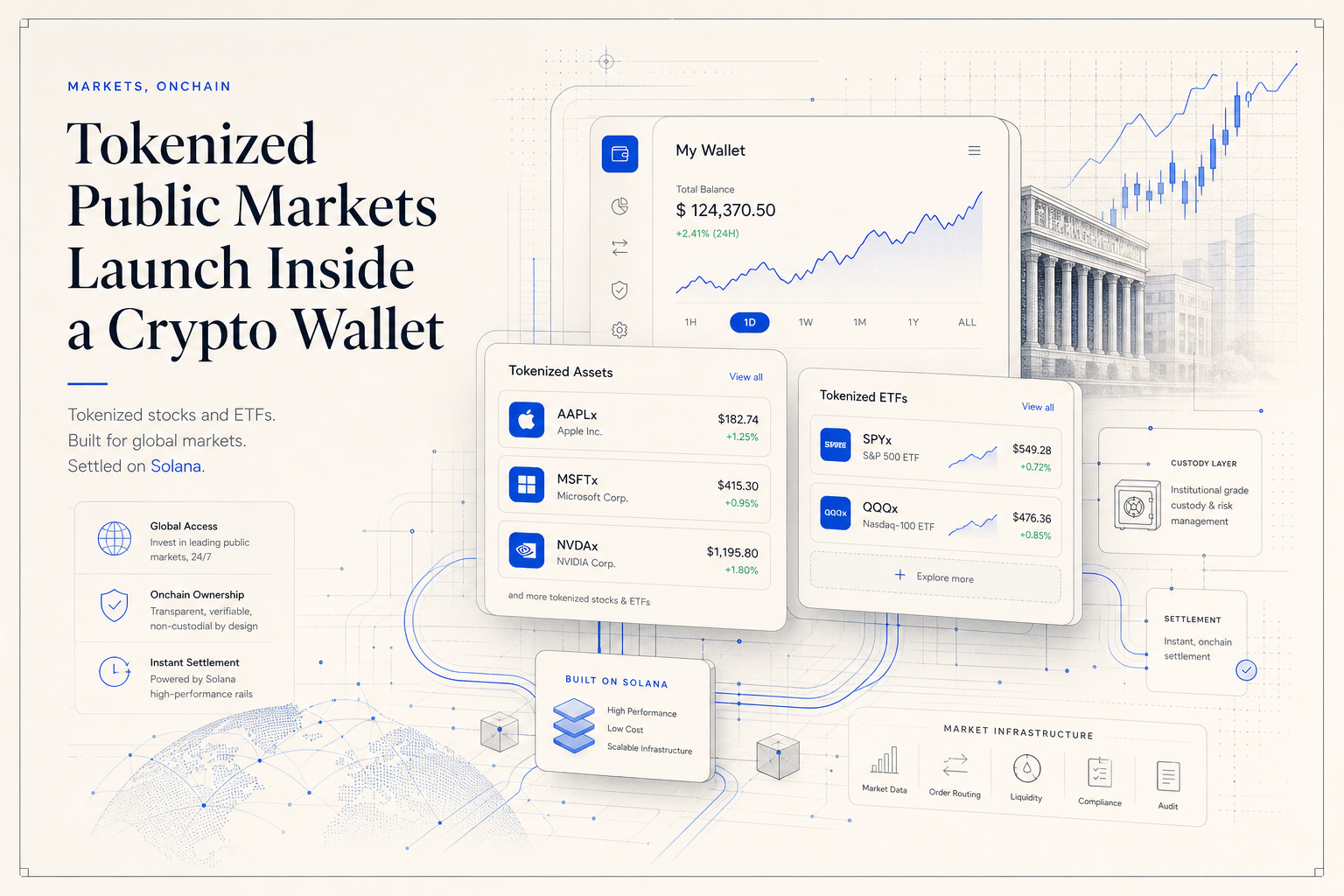
Exodus has opened a new front in tokenized market distribution by bringing more than 200 tokenized stocks, ETFs, and other real-world market instruments directly into its wallet app through a launch built with Ondo on Solana. The significance is less about one more product menu and more about where the product now lives. Tokenized public market access is moving out of specialist broker-style interfaces and into mainstream crypto wallet surfaces, where users already custody assets, move stablecoins, and manage onchain positions. That shift could meaningfully lower the friction between holding digital assets and accessing regulated market exposure.
According to the company’s launch materials, eligible users can access the new Exodus Markets feature after updating the app, with the offering limited to supported jurisdictions. The product includes more than 200 tokenized equities and ETFs, and Exodus says the assets trade on Solana rails inside the wallet experience rather than through a separate destination. That distribution choice matters because wallets increasingly serve as the operating system for onchain finance. When tokenized assets are embedded at that layer, the user journey starts to look less like a crypto sidecar to traditional brokerage and more like a unified account model for digital money and market exposure.
There is also an important legal and product-design caveat. Exodus states that the tokenized instruments are not the same as holding the underlying securities directly and do not confer shareholder rights. That distinction should not be treated as fine print. It is central to how this market is being built. Tokenized access can deliver price exposure, faster settlement, portability, and round-the-clock programmability, but it does not automatically recreate the full bundle of rights that comes with conventional equity ownership. For users and platforms alike, the next phase of tokenized public markets will depend on how clearly those boundaries are disclosed and how consistently they are handled across jurisdictions.
The launch also extends a longer arc for Exodus itself. The company has been tied to tokenization since it tokenized its own stock in 2021, and the new marketplace expands that earlier experiment into a broader consumer product. In practical terms, Exodus is using its wallet audience as distribution for tokenized capital-markets inventory rather than treating tokenization as a stand-alone issuance story. That is a more mature posture. It suggests wallet providers increasingly see tokenized securities and funds not as occasional promotional listings, but as part of a permanent onchain product shelf that can sit alongside spot crypto, payments, swaps, and yield products.
Ondo’s role is equally important. Its Global Markets framework is designed around tokenized stocks, ETFs, and ADRs, alongside its better-known yield-bearing products, and its disclosures make clear that access remains jurisdiction-specific and tied to securities-law constraints. That combination captures the real shape of the current market: the technology stack is becoming easier to distribute, but the compliance perimeter remains highly structured. Solana’s inclusion adds another layer to the story. The chain’s throughput and low-cost settlement make it a practical venue for consumer-facing distribution, especially where platforms want to support frequent trading activity without bringing users into a high-fee environment.
What makes this rollout notable for the broader RWA market is the convergence of three layers that have often developed separately: issuance infrastructure, blockchain settlement, and end-user distribution. Many tokenization efforts have shown that real-world assets can be represented onchain. Fewer have shown that the resulting instruments can be placed directly inside products with large retail crypto footprints. If tokenized public markets are going to scale beyond a specialist audience, distribution through familiar wallet and exchange environments is likely to matter as much as the tokenization mechanics themselves.
The next questions are operational rather than conceptual. Market depth, supported geographies, the handling of corporate actions, and the treatment of rights versus exposure will determine whether users treat tokenized equities as a serious portfolio tool or a novelty. Even so, the Exodus launch is a concrete sign that tokenized public markets are moving closer to the front end of crypto consumer finance. The RWA story here is not only that more assets are coming onchain, but that the interface through which people discover and trade them is becoming native to the wallet layer.