Dubai tests registry-native property tokenization with secondary-market rails
Dubai’s real-estate tokenization push is gaining importance not because investors can buy smaller slices of property, but because the ownership record is being linked directly to official registry infrastructure. With controlled secondary trading now part of the pilot stack, the project is becoming a live test of whether property rights can move onto digital rails without losing legal enforceability.
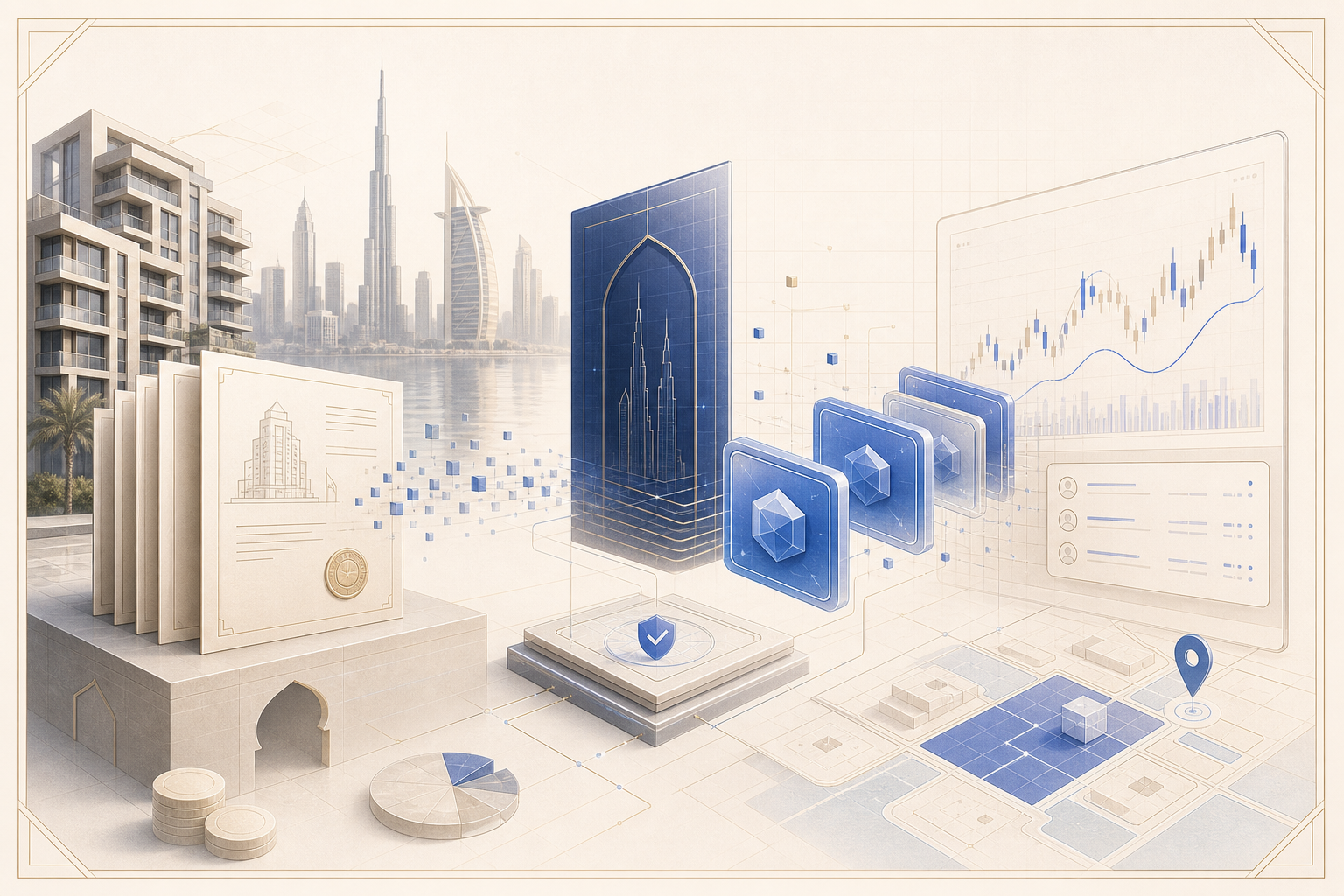
Dubai’s latest real-estate tokenization push is becoming notable for a reason that goes well beyond a low entry ticket for investors. The important shift is that ownership interests are being tied directly to the official land-registry system rather than being routed through a stack of special-purpose vehicles, nominee structures and off-chain administration. That design choice moves tokenization closer to core market infrastructure. Instead of using blockchain mainly as a distribution wrapper, Dubai is testing whether property rights, transfer mechanics and secondary-market controls can be coordinated around the authoritative record of ownership itself.
That distinction matters because fractional property investing is not new, but most earlier models stopped short of changing the registry layer. Investors typically bought shares in an entity that held a property, which made access cheaper but left legal complexity, servicing costs and transfer friction in place. Recent industry commentary around Dubai’s rollout has highlighted that the economics start to look different when the token is connected to the source record instead of sitting one layer removed from it. In practical terms, that can reduce administrative overhead, tighten reconciliation between digital and legal ownership, and make secondary transfers easier to govern inside a regulated framework.
The strongest public evidence for that architecture comes from Ctrl Alt, the tokenization infrastructure partner working with Dubai Land Department on the project. In a February press release announcing phase two of the pilot, Ctrl Alt said the first stage had already tokenized ten properties representing more than AED 18.5 million in value, and that roughly 7.8 million tokens issued during the pilot would become eligible for resale in a controlled secondary-market environment. The company also said its systems are directly integrated with Dubai Land Department records so title-deed ownership can be issued, managed and transferred on-chain while remaining aligned with the official registry.
That phase-two announcement is important because it clarifies that the market is not only experimenting with primary issuance. Dubai is also testing whether regulated secondary trading can work without breaking the chain of title or the supervisory model around property transfers. Ctrl Alt said the pilot continues to use the XRP Ledger and Ripple Custody as part of the operational stack, while asset-referenced management tokens are being used to support compliant transfers. The result is a more ambitious proposition than a one-off token sale: a controlled market structure in which issuance, custody, registry synchronization and resale all have to function together.
The distribution side of the story also appears to be moving into a consumer-access phase. PRYPCO Mint, the public-facing marketplace tied to the initiative, describes itself as a VARA-licensed platform launched in strategic partnership with Dubai Land Department. Its live product materials market tokenized Dubai property with minimum access from AED 2,000, position the experience as blockchain-backed fractional ownership, and state that investors pay 2% in Dubai Land Department fees instead of the standard 4%. The platform also advertises a 24/7 marketplace experience and projected net annual returns of 8% to 12%, while noting that those figures are projections rather than guarantees.
Taken together, those details show why Dubai has become one of the more closely watched real-world asset jurisdictions this year. The hard problem in tokenization is rarely minting the digital unit. It is building the legal, operational and payments infrastructure around that unit so ownership can be enforced, transfers can be supervised, and settlement can fit into existing compliance and banking workflows. Recent commentary from market participants involved in the project has stressed exactly that point: tokenization only becomes economically meaningful when the registry, the transfer rules, the investor access layer and the money movement rails can all interoperate.
There are still clear limits. Tokenization does not make individual properties liquid in the way listed equities are liquid, and it does not eliminate valuation risk, vacancy risk, legal disputes or the operational realities of managing real estate. Even with on-chain records, secondary activity has to be governed carefully, and a controlled pilot is very different from an open global market. Dubai’s model may also be easier to execute than in jurisdictions where land records are fragmented across local authorities and legacy paperwork remains deeply embedded in conveyancing and court processes.
Even so, the significance of this rollout is hard to ignore. If Dubai can prove that registry-native tokenization supports compliant issuance, lower-friction investor access and credible secondary trading, it will offer one of the clearest templates yet for how property can move onto digital rails without severing the legal foundations that make ownership meaningful in the first place. For the broader RWA market, that is the real signal: the next phase of tokenization will be won less by flashy wrappers and more by jurisdictions and infrastructure providers that can connect blockchain records to the institutions that actually recognize, transfer and defend asset ownership.