Crédit Agricole brings EURXT to market as a euro stablecoin for tokenized fund settlement
Crédit Agricole’s asset-servicing arm has launched EURXT as a MiCA-aligned euro settlement token aimed at institutions and corporates. The first live use case tied the token to a subscription into an Amundi money market fund, giving Europe another concrete example of bank-issued stablecoins being built around fund plumbing rather than retail crypto trading.
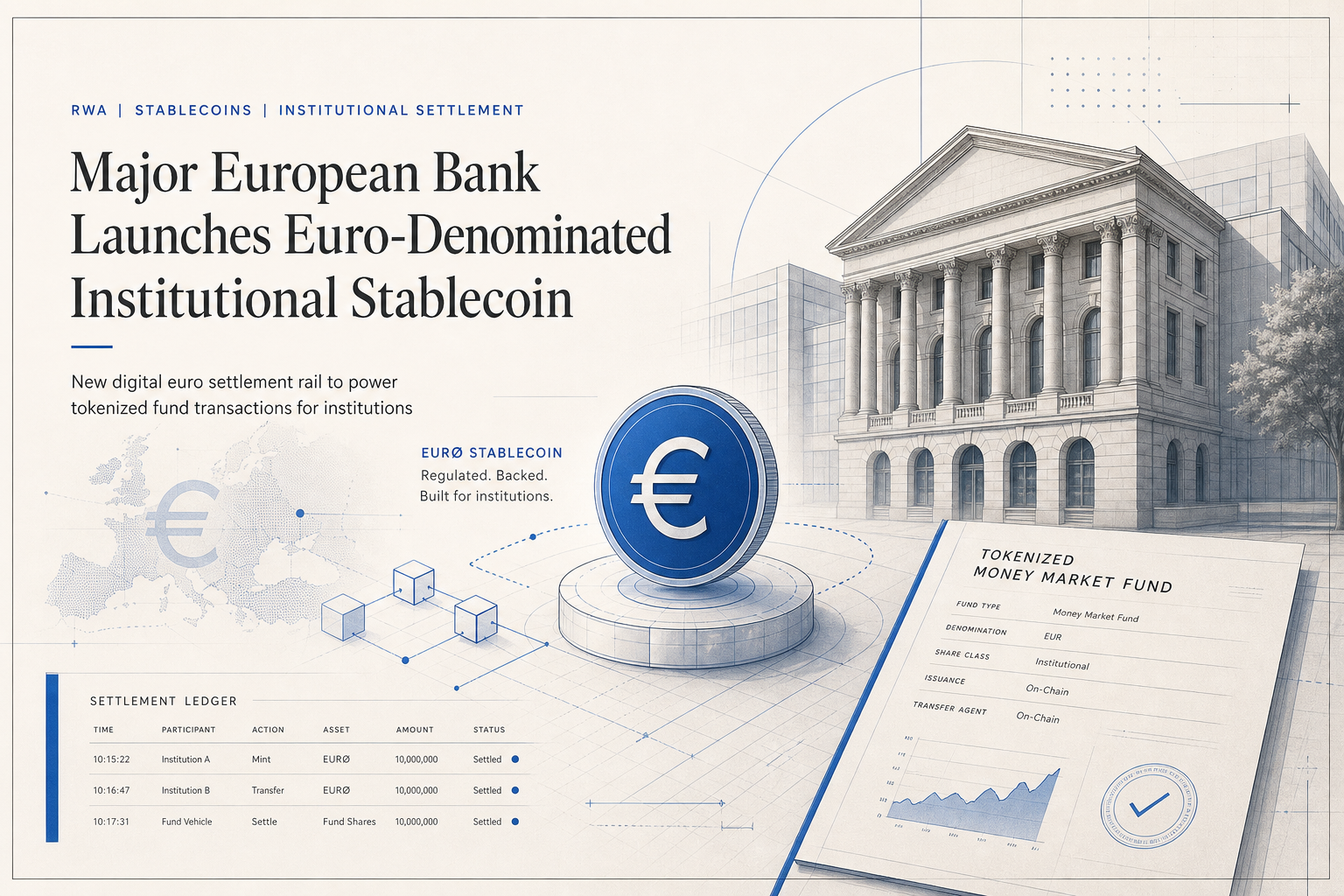
Crédit Agricole has taken a meaningful step deeper into onchain finance with the launch of EURXT, a euro-denominated stablecoin issued by its asset-servicing subsidiary CACEIS Bank. The move matters less as a headline about another fiat-backed token and more as evidence of where European bank-led stablecoin strategies are actually going: toward settlement infrastructure for funds, treasury workflows and institutional payments. In this case, the launch arrived with an immediate live transaction rather than a concept note. CACEIS said the token was used for an initial subscription into the Amundi Money Market Fund, giving the product a capital-markets use case from day one.
The structure CACEIS has described is straightforward and deliberately conservative. EURXT is issued on Ethereum using the ERC-20 standard and is designed as an electronic money token pegged one-to-one to the euro. In its launch materials, CACEIS said the token is initially being made available to institutional investor clients and corporate clients, not pitched as a broad retail trading product. That positioning is important because it shows how incumbent financial groups are framing stablecoins in Europe: not as speculative instruments, but as programmable cash equivalents that can sit inside familiar servicing, custody and fund-administration workflows.
The most concrete proof point in the launch is the Amundi transaction. According to CACEIS, the first issuance was used to settle a subscription into a tokenized Luxembourg-domiciled UCITS money market fund, which it described as a European first for a euro stablecoin. That detail gives EURXT a stronger starting point than many bank token announcements, which often emphasize future potential without naming a completed settlement flow. Here, the bank is effectively arguing that tokenized cash and tokenized funds can move together inside the same operating stack, reducing friction in subscription and redemption processes while shortening settlement cycles for eligible market participants.
The reserve and redemption design also lines up with the more tightly regulated model Europe is pushing under MiCA. CACEIS said EURXT is backed at one-to-one parity by fiat euros and secured by dedicated reserves consisting exclusively of cash held on the balance sheet of CACEIS Bank. The EURXT white paper adds that there is no issuance cap, that supply expands according to demand, that holders have a right to redeem at par, and that the token does not pay interest. Those terms matter because they place EURXT squarely in the category of regulated settlement media rather than yield-bearing quasi-bank products. For institutions evaluating stablecoin rails, predictable redemption rights and cash-only reserve language are likely to carry more weight than growth marketing.
The regulatory backdrop is another reason the launch qualifies as real progress rather than experimentation theater. CACEIS previously announced that it had obtained MiCA authorization from France’s ACPR following advice from the AMF, and said that status gives it European passporting rights for covered crypto-asset services across the EU. By pairing that regulatory footing with a bank-issued token and a live fund-subscription use case, Crédit Agricole is showing a fuller stack: authorization, issuance, reserves, and a production settlement workflow. That combination is what many tokenization efforts have been missing, especially in Europe where compliance sequencing tends to determine whether pilots can graduate into durable product lines.
The launch also sharpens the competitive picture for euro stablecoins. Most of the market conversation still revolves around dollar tokens, but tokenized securities and fund flows in Europe need euro liquidity that can move with the same programmability as the assets they settle. A bank-affiliated token such as EURXT will not win distribution simply by existing, and it still has to prove operational reliability, liquidity access and integration depth. Even so, the decision to start with institutional settlement rather than consumer payments gives the project a clearer path to relevance. If the token becomes useful anywhere, it is likely to be in exactly these controlled environments where fund managers, transfer agents, custodians and treasury teams all care about reconciliation, legal certainty and same-stack settlement.
For RWA markets, that is the bigger signal. EURXT suggests that large financial institutions increasingly see tokenized cash as a necessary companion product to tokenized funds, not a separate crypto experiment. When a bank, an asset servicer and a major fund complex can connect tokenized money with tokenized fund subscriptions inside a regulated framework, the conversation moves beyond pilot language and toward operating infrastructure. Europe still has open questions around liquidity venues, secondary-market depth and broader distribution, but Crédit Agricole has now put a concrete institutional stablecoin use case on the board.