Coinbase puts USDC at the center of machine-to-machine payments
Coinbase is extending USDC from a trading and transfer instrument into a programmable payment rail for autonomous software, pairing business payment APIs with x402 and agent tooling. The move matters because it gives stablecoins a clearer path into API commerce, automated treasury actions and paid data flows that do not depend on a human checkout step.
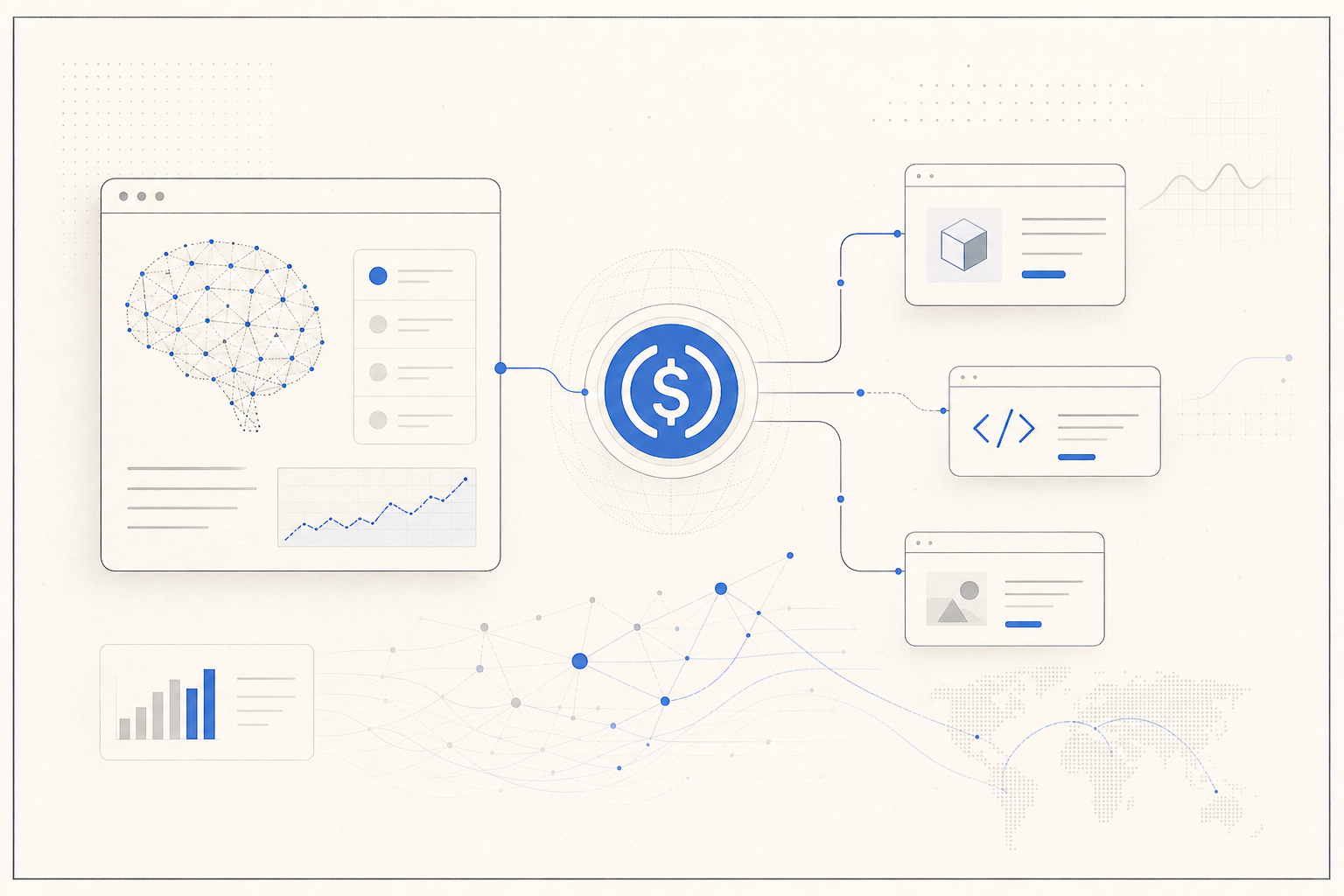
Coinbase is making a more concrete bet on what stablecoins might look like when the payer is software rather than a person. The company said businesses using Coinbase Business will be able to accept USDC payments from AI agents, while a parallel set of trading tools and developer tooling is meant to let those agents manage financial actions with less human intervention. That is more than a product tweak. It is an attempt to move stablecoins out of the familiar wallet-to-wallet transfer model and into the operating layer of internet commerce, where software services, data providers and automated workflows increasingly need a native way to charge one another in real time.
The payment rail at the center of that effort is x402, the open protocol Coinbase introduced around the long-unused HTTP 402 Payment Required status code. In Coinbase’s developer documentation, x402 is described as a way to enable instant stablecoin payments directly over HTTP, so that a service can request payment programmatically and a buyer can settle access without creating an account, opening a session or going through a manual checkout flow. Coinbase explicitly frames the buyer side of that model as both human developers and AI agents, and its published use cases include paid API requests, machine-purchased access to tools and digital content, and microtransaction-based service monetization. In practical terms, that means the company is trying to turn USDC into a default settlement layer for software interactions that happen one request at a time.
Coinbase Business provides the commercial wrapper around that protocol. The company’s business API documentation says customers can programmatically make payments, trade, transfer funds and track account activity, while also integrating crypto payment collection, payouts and stablecoin onramps and offramps. Putting x402 together with those business APIs creates a fuller stack than a simple merchant checkout button. A company can in principle receive USDC from a software agent, route those funds into treasury operations, move balances between fiat and stablecoins, and manage the resulting transaction records from the same platform. That kind of workflow is especially relevant for firms selling data, compliance services, analytics, market access and other digital products that may increasingly be purchased by automated systems rather than by employees clicking through a billing page.
Coinbase’s broader AI tooling helps explain why it is pushing this now. Its AgentKit documentation positions the product as a toolkit for building agents that can hold wallets and perform onchain actions, while its Agentic Wallet tooling is designed to let those agents discover and pay for services through x402 without juggling seed phrases or bespoke API keys. Coinbase also says payments in that wallet stack are supported on Base, Polygon and Solana, which suggests the company is not treating agentic commerce as a single-chain experiment. The strategic point is straightforward: if AI agents are going to browse, negotiate, purchase data, rebalance positions or trigger treasury actions on behalf of users, they need identity, wallets, funding rails and spend logic that work at software speed. Coinbase is trying to supply all of those pieces before that workflow standardizes elsewhere.
For the stablecoin market, the significance is that this is a demand-side expansion story, not only a distribution story. Stablecoin growth over the last two years has been driven heavily by exchange settlement, payments, remittances and treasury management. Machine-native payments add another category: programmable consumption of digital services. If an AI agent can pay a few cents for a pricing endpoint, a compliance check, an index file, a research data packet or a document retrieval request, stablecoins start to function less like a digital cash substitute and more like an internet billing primitive. That is a useful framing for RWA infrastructure as well, because the data services surrounding tokenized funds, private credit, collateral monitoring and secondary market access are exactly the kinds of products that may be sold in small automated increments.
There are still meaningful constraints between the current launch and broad adoption. Businesses will need confidence around spend controls, refunds, dispute handling, accounting treatment, sanctions screening and how autonomous purchases are authorized inside enterprise systems. Developers also have to decide whether the economics of per-request onchain payments hold up once gas costs, wallet management and chain fragmentation are considered. Coinbase’s own design choices show that it understands that problem: the company is coupling the payment protocol with business APIs and wallet tooling instead of treating settlement alone as the product. Even so, the real test will be whether buyers and sellers actually redesign workflows around automated payment requests rather than simply adding a stablecoin option to existing checkout patterns.
Even at this early stage, the direction is clear. Coinbase is no longer talking about stablecoins only as exchange collateral or cross-border transfer instruments. It is building toward a world where software agents can hold balances, make bounded decisions and pay for access to financial and informational services over open rails. If that model gains traction, USDC could become one of the first major dollar instruments to find product-market fit inside autonomous software commerce. That would give the stablecoin sector a new growth channel and give the wider tokenization stack a more credible payments backbone for machine-driven markets.