Citi’s first Kaleido deal shows how banks want to package private-market equity for tokenized distribution
Citi’s reported first private-share tokenization with Kaleido matters less as a one-off placement than as a signal that large banks are trying to industrialize private-market distribution. The structure points to a more bank-led model built around custody, depositary receipts and tightly controlled investor access.
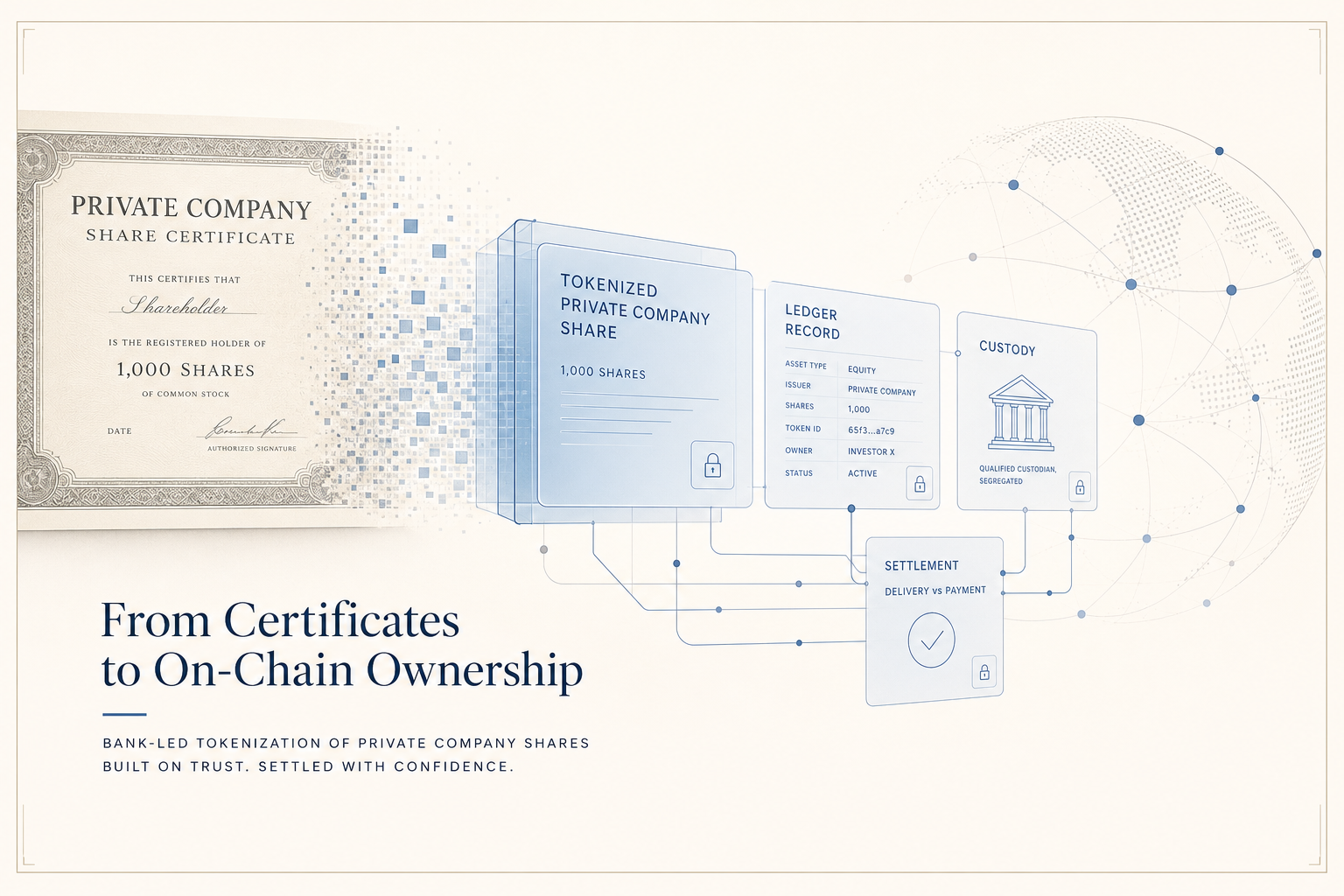
Citi’s first reported tokenized private-share deal offers a clearer picture of where bank-led equity tokenization may actually scale. The transaction centers on Kaleido, an enterprise blockchain and digital-asset infrastructure company, and appears to be the first live use of the private-market tokenization framework Citi said last year it was building with Switzerland’s SIX Digital Exchange. On the surface, the story is about one private company and one distribution program. Underneath, it is a test of whether global banks can turn tokenization into a trusted packaging layer for private equity exposure without relying on the looser structures that have dominated crypto-native markets.
The basic structure is important. Citi has said its SDX initiative is aimed at venture-backed, late-stage private companies and at eligible private and institutional investors. In the current Kaleido transaction, the tokens reportedly take the form of depositary receipts issued in collaboration with the company, with Citi acting as issuer and custodian. That differs from the special-purpose-vehicle model that has often been used to bring private assets onchain. In an SPV setup, investors typically rely on an intermediate entity to hold the real shares, which can introduce extra legal layering, governance questions and counterparty trust. Citi’s pitch is that a bank-centered issuance and custody stack can reduce some of that complexity.
Why start with Kaleido? The choice is strategically neat. Kaleido is not just another venture-backed software company; its own public materials position it as an enterprise blockchain, tokenization and digital-asset platform with products spanning token lifecycle management, custody tooling and digital cash infrastructure. Its site also highlights work connected to large financial institutions and global payments infrastructure, including Swift-linked initiatives. In other words, Citi did not begin with a consumer-facing growth story. It began with a company whose business already sits inside the institutional digital-assets buildout, which lowers the educational burden for buyers and gives the distribution experiment a more industry-native first asset.
The geography also matters. Citi’s original SDX plan was built around a regulated digital market infrastructure in Switzerland, and the current reporting suggests the first target audience is outside the United States even if U.S. distribution remains a longer-term goal. That is a familiar pattern in tokenization. Jurisdictions with clearer pathways for digital securities, regulated central securities infrastructure and cross-border private wealth distribution often become the first deployment zone, while U.S. expansion waits on a more comfortable legal and operational perimeter. For banks, that sequencing can turn offshore or international channels into a proving ground before they push the model into the more complicated U.S. private-securities environment.
The bigger significance is that this is not a retail-access story. The structure appears designed for high-net-worth and institutional buyers, which makes sense given shareholder-count limits, transfer restrictions and the coordination required with the underlying private company. That may sound limiting, but it is probably the more realistic path for early bank-issued tokenized equity products. Rather than promising instant global retail liquidity, the model uses tokenization to improve distribution, recordkeeping, custody alignment and potentially secondary transfer workflows within a narrow, regulated investor set. In other words, the near-term value proposition is operational and market-structure efficiency before it is mass access.
This also gives a useful contrast with the crypto-native side of private-market exposure, where many products track valuation through synthetic contracts, perpetuals or SPV-backed wrappers. Those instruments have helped prove demand, including for marquee private names already visible in the RWA Trails catalog such as SpaceX. But a bank-led framework is trying to compete on different terrain: legal certainty, issuer coordination, recognized custody and the ability to plug tokenized distribution into existing wealth and institutional channels. If that works, it could produce a more conservative but more scalable route for large private issuers that care less about open trading and more about controlled capital formation.
For the broader RWA stack, the Kaleido deal is best read as a signal that tokenization is moving further into product-market fit questions. The technology is no longer the whole story. The harder work is deciding who issues the claim, who holds the underlying, which investors can own it, where settlement occurs and which market infrastructure can support distribution without breaking securities-law boundaries. Citi’s first move with Kaleido suggests one answer: start with a regulated exchange environment, use bank custody as the trust anchor, keep eligibility tight and prove that private shares can be distributed in tokenized form without sacrificing institutional controls. If more banks adopt that template, private-market tokenization may expand not through open crypto rails first, but through highly managed channels that slowly normalize digital securities inside traditional finance.