Circle’s Korea Push Moves Closer to Consumer Payments Through Kakao and Toss Bank
Circle has signed separate agreements with Kakao Group and Toss Bank to explore stablecoin-based payment infrastructure in South Korea. The partnerships matter because they connect USDC’s always-on settlement model with two of the country’s best-known digital finance ecosystems.
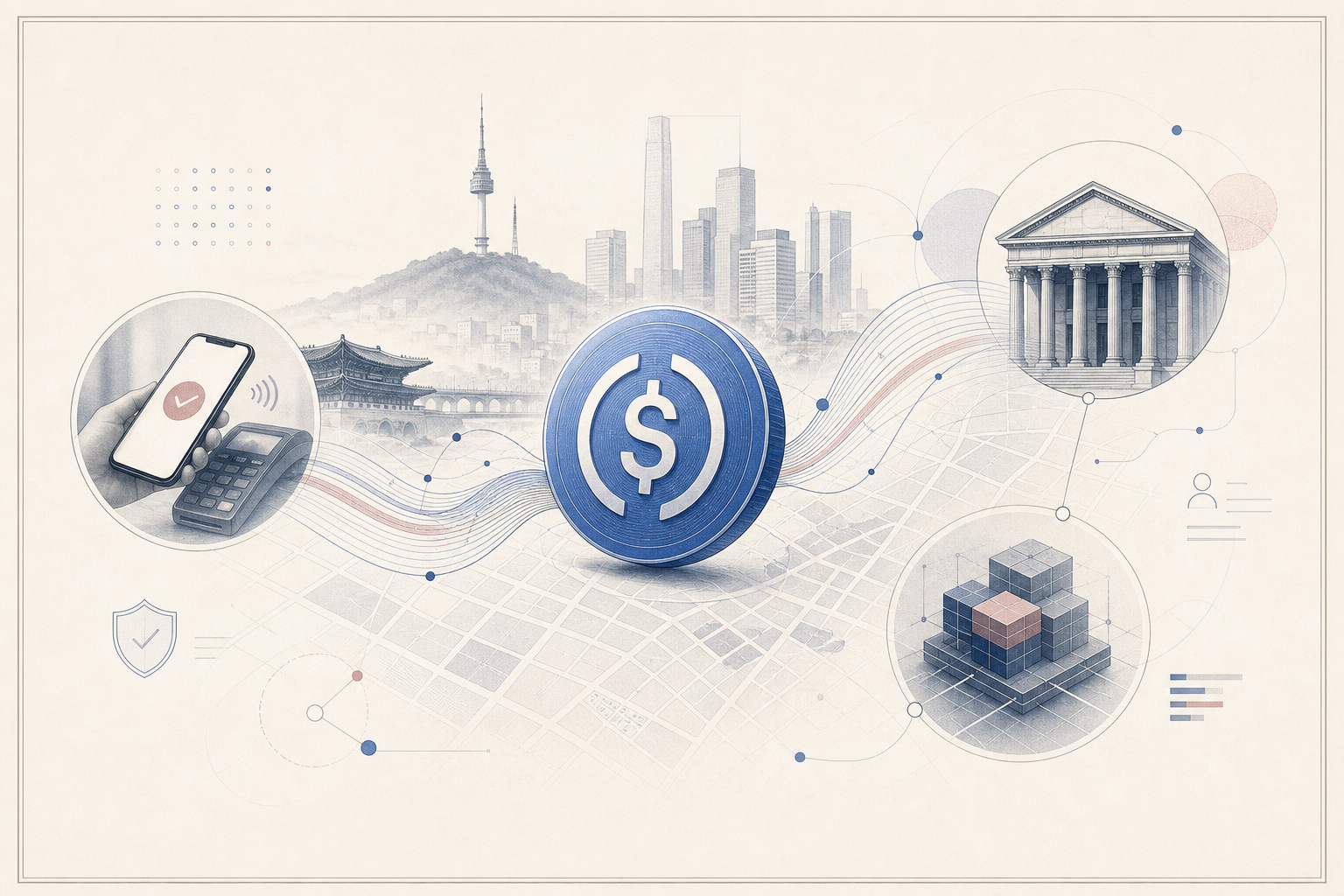
Circle’s latest partnerships in South Korea are notable less for what has already launched than for where the company is trying to insert stablecoins next. The issuer said it has signed separate agreements with Kakao Group and with Toss and Toss Bank to explore blockchain-based payment infrastructure in the country. That framing is important. This is not a merchant rollout or a production payment launch yet. It is a deliberate attempt to connect Circle’s stablecoin and settlement stack with mainstream Korean consumer-finance platforms, where the operational questions are less about crypto trading access and more about whether stablecoin rails can support real payment, settlement and treasury flows at consumer scale.
Circle’s own statements are fairly specific about the areas under review. In its announcement on the Kakao relationship, the company said the two sides will assess where USDC and Circle’s payment network could fit into consumer payments, settlement workflows and broader digital-asset connectivity in Korea. In its separate statement on Toss and Toss Bank, Circle said the work will focus on blockchain-based payment infrastructure and stablecoin technology, with an emphasis on payment opportunities inside one of Korea’s most widely used fintech environments. Read together, the memoranda suggest Circle is trying to localize a familiar thesis: stablecoins become more strategically valuable when they are embedded inside trusted payment surfaces rather than left at the edge of crypto markets.
The product logic behind that effort is straightforward. Circle markets USDC as a dollar-backed token redeemable one-for-one for U.S. dollars and designed for always-on liquidity and fast global payments. Those characteristics are useful in cross-border treasury movement, exchange settlement and digital-asset trading, but they become more commercially powerful when paired with institutions that already own user relationships. Kakao’s payments footprint and the Toss franchise’s banking and fintech interfaces offer exactly that kind of potential distribution. Even if the first practical deployments remain narrow, the counterparties give Circle a plausible path from infrastructure provider to embedded payments layer.
That is why the Korean angle matters. South Korea has long had deep digital-finance adoption, highly engaged crypto users and strong domestic platform ecosystems, yet stablecoin distribution there still depends heavily on the willingness of local financial and technology groups to test where blockchain rails fit into existing consumer behavior. Circle is not trying to rebuild those interfaces from scratch. It is trying to place USDC and related services underneath them, where stablecoins can handle settlement, liquidity movement or cross-platform transfers without forcing the end user to think like a crypto trader.
The two relationships also show Circle broadening its go-to-market beyond the exchange channel. Stablecoin issuers initially gained traction through trading venues and DeFi liquidity. The next phase is more operational: treasury routing, merchant settlement, remittances, payout flows and platform-native payment experiences. Working with a large technology ecosystem on one side and a digital bank on the other lets Circle test both. Kakao can expose where stablecoin rails fit inside consumer internet and commerce adjacencies, while Toss Bank can help surface the harder banking questions around user trust, integration design, compliance handling and settlement workflows.
None of that guarantees a fast commercial rollout. South Korea remains a market where payment infrastructure, banking expectations and digital-asset policy all require careful coordination, and memoranda of understanding are not the same thing as product approvals. But exploratory agreements at this layer are still strategically meaningful. They indicate that stablecoin infrastructure is being evaluated not just by crypto exchanges and offshore trading desks, but by firms that operate close to everyday payments. That shift is one of the clearest markers of how the stablecoin market is maturing.
For RWA and stablecoin watchers, the real signal is that payment-rail competition is moving toward distribution partnerships, not only reserve scale. Circle already has size and liquidity behind USDC. What it needs next is durable insertion into local financial interfaces where users already store balances, move money and settle transactions. The Kakao and Toss Bank agreements do not prove that model yet, but they show where the battle for stablecoin utility is heading: into regulated, high-frequency payment environments where the value of always-on digital dollars can be tested against real consumer and bank workflows.