Cantor and Securitize push tokenization upstream into the IPO workflow
Cantor Fitzgerald and Securitize are trying to move tokenization beyond post-listing wrappers and into the issuance process itself. Their new tie-up is aimed at giving public companies a compliant path to sell and service securities onchain inside familiar capital-markets workflows.
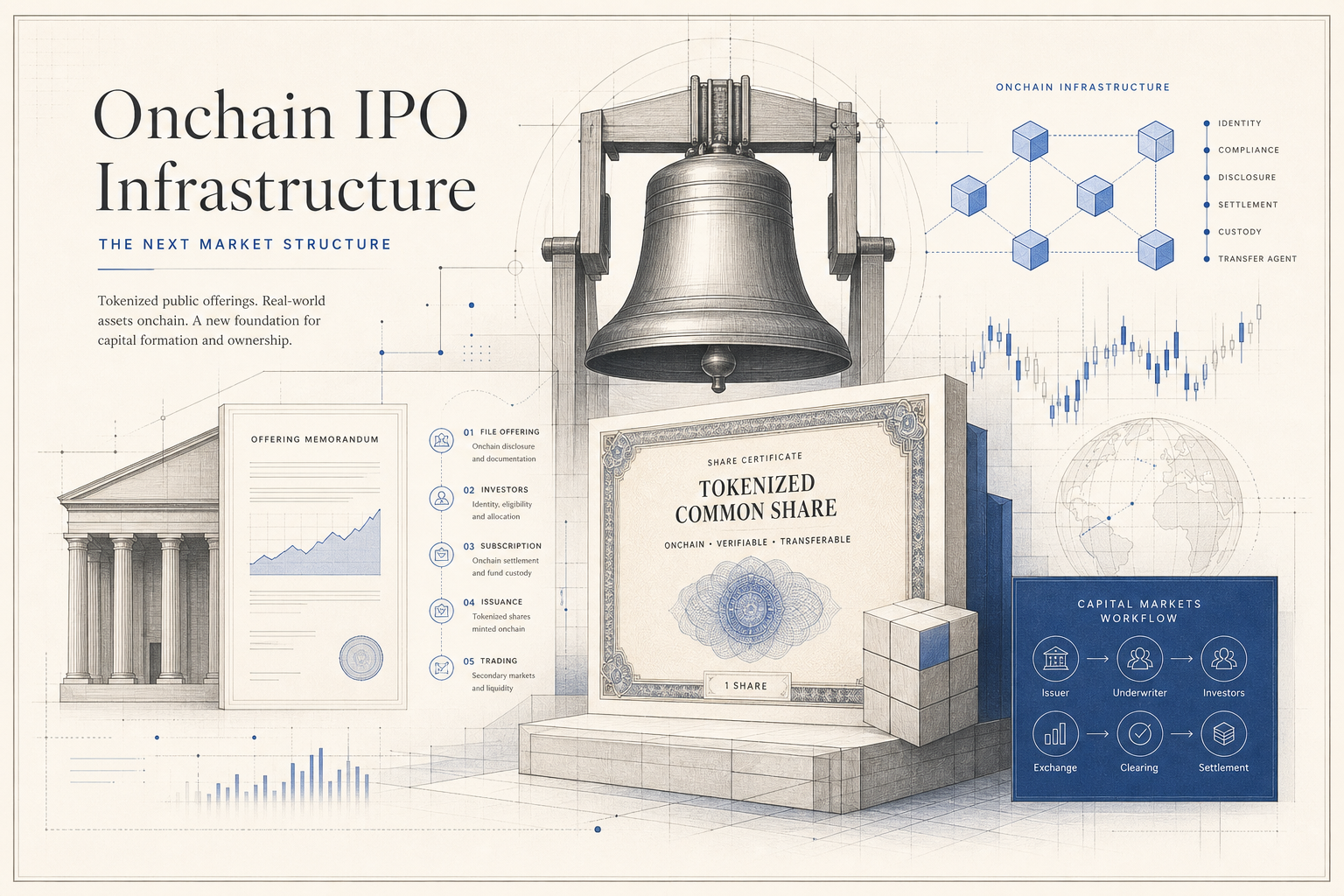
Cantor Fitzgerald and Securitize are making a more ambitious bet on tokenized securities than the market’s earlier experiments with wrapped equities and isolated private placements. The companies said they will work together on infrastructure for onchain initial public offerings and follow-on offerings, combining Cantor’s equity capital markets and trading capabilities with Securitize’s issuance, distribution and servicing stack. The practical significance is that tokenization would no longer be treated as a separate aftermarket overlay. Instead, it would be inserted into the moment a company actually raises capital, with the token representing the security from the outset rather than mirroring it after the fact.
That design choice is the central story. According to the companies’ announced framework, the model is meant to support issuer-sponsored securities issued on blockchain rails while remaining inside the established regulatory path for public offerings. In other words, the aim is not to create a side market that sits outside securities law. The aim is to modernize recordkeeping, distribution and settlement while preserving the disciplines public issuers and underwriters already understand. For RWA builders, that is a meaningful shift: tokenization becomes part of primary market plumbing rather than a niche product that only appears after a conventional issuance is complete.
The partnership also fits Securitize’s broader trajectory. The company has spent the last year positioning itself less as a one-off token issuance provider and more as full-stack market infrastructure for real-world assets. Its public materials already highlight tokenized fund distribution, primary market workflows and digital securities administration, and earlier announcements showed it working on native tokenization of public shares on Ethereum with other partners. This new arrangement extends that logic into capital formation itself. If tokenized funds were the first proof that traditional assets could move onchain, onchain IPOs would test whether public equity issuance can follow the same path.
Cantor’s role matters because tokenized securities projects often stall when they cannot connect blockchain infrastructure to actual underwriting, market access and distribution channels. A broker-dealer or tokenization platform can demonstrate the technology, but public offerings still depend on institutional placement, compliance processes, investor onboarding and post-deal market support. Cantor brings those traditional market functions to the table. That does not guarantee adoption, but it addresses one of the biggest reasons tokenization pilots fail to graduate into production: the absence of an incumbent capital-markets operator willing to integrate the new rails into a mainstream issuance workflow.
There is also a strategic angle in the existing relationship between the two firms. Securitize is already in the process of becoming a public company through a business combination with Cantor Equity Partners II, and the companies have separately disclosed SEC filing work tied to that transaction. That backdrop makes the new IPO initiative easier to read. This is not a loose memorandum between unfamiliar counterparties. It is an extension of a deeper commercial alignment in which Cantor is both financially and operationally close to Securitize’s platform strategy. For prospective issuers, that continuity could matter more than the headline itself, because it suggests the companies are trying to build repeatable market structure rather than stage a symbolic pilot.
What remains unclear is just as important as what has been announced. The firms have not yet laid out detailed launch timelines, target issuer profiles, custody architecture, transfer-agent roles, exchange connectivity or how secondary liquidity would be handled once an offering is complete. Those unanswered questions are material. Public-company issuance is constrained not only by technology but by disclosure obligations, market surveillance, shareholder record rules and interoperability with existing market utilities. Any serious onchain IPO model will have to solve those operational details without turning the blockchain component into a cosmetic feature.
Even with those open questions, the announcement deserves attention because it moves the tokenization conversation to a harder and more consequential layer of the stack. Much of the last cycle focused on tokenized access to assets that already existed elsewhere. This initiative targets the creation of the asset itself at issuance. If that model proves workable, tokenization stops being mainly about distribution efficiency for private funds and starts competing for a role in the public equity pipeline. That would be a bigger prize for RWA infrastructure providers and a stronger signal that onchain finance is edging from product experimentation toward core capital-markets workflow.