Brazil’s Pix Trade Dispute Highlights Stablecoins’ Expanding Role in Dollar Settlement
Washington’s latest trade action against Brazil has put Pix under a geopolitical spotlight just as dollar-backed stablecoins deepen their role in the country’s digital payments economy. The result is a clearer picture of how domestic instant-payment rails and crypto dollar settlement are starting to coexist rather than compete head-on.
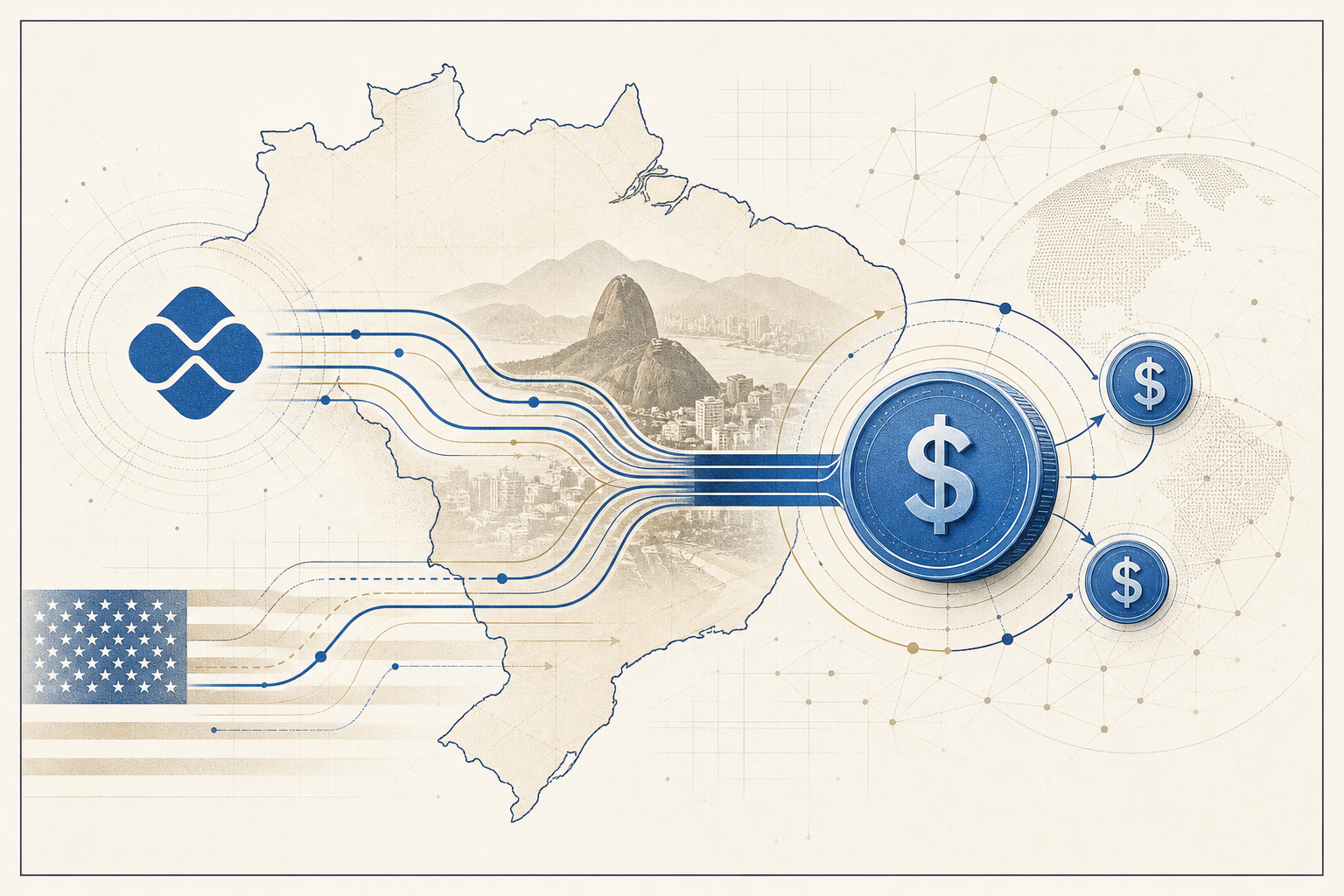
The latest U.S.-Brazil trade clash is no longer just about tariffs on goods. It is also becoming a dispute over who controls the rails of digital money. In a July 2026 action, the Office of the United States Trade Representative said it would impose a 25% tariff on certain Brazilian goods after a Section 301 investigation that covered digital trade and electronic payment services among other issues. That matters for digital-asset markets because Brazil’s homegrown payments stack is now large enough to be treated as strategic infrastructure, not simply as consumer fintech. Once payment networks become matters of trade policy, the line between public payments, private financial infrastructure and tokenized money gets much thinner.
At the center of the story is Pix, the instant-payment scheme created by Banco Central do Brasil. The central bank describes Pix as a system that lets people, companies and government entities send or receive transfers in seconds at any time, including non-business days, while lowering costs through a structure with fewer intermediaries. Since launching in November 2020, Pix has become deeply embedded in Brazilian daily commerce. The central bank’s own statistics page now says more than 170 million individuals have used Pix, equivalent to roughly 80% of the population. It also reports more than 7 billion Pix transactions in January 2026 alone, with a record 313.3 million transactions completed in a single day in December 2025.
Those figures help explain why Washington is paying attention. The USTR action frames Brazilian measures around digital trade and electronic payment services as practices that burden or restrict U.S. commerce. In practical terms, Pix has matured from a domestic convenience into a national-scale alternative to legacy card and bank-transfer economics. For global payment incumbents, that changes the competitive map. For policymakers, it raises a different question: when a central bank builds a ubiquitous retail rail with low user costs and broad access, is it simply modernizing payments, or is it also reshaping the commercial terrain for foreign providers? That question is now being tested in a trade arena rather than only in a payments-policy one.
The stablecoin angle is what makes the Brazil story especially relevant for RWA and tokenized-finance builders. Even as Brazil has been associated with broader BRICS discussions around reducing dependence on dollar-based infrastructure, demand for digital dollars appears to be rising inside the country’s crypto economy. Brazilian tax-authority data indicates that dollar-linked stablecoins account for the overwhelming majority of local crypto transaction volume, with much of that activity tied to payments and settlement rather than purely speculative trading. That creates an important contrast. Brazil may be promoting sovereign and domestic payment rails at the policy level, but market participants are still choosing blockchain-based dollar instruments when they need portability, always-on settlement, or access to offshore liquidity.
That does not necessarily make Pix and stablecoins direct rivals. They solve different parts of the money stack. Pix is optimized for domestic retail transfers in local currency, bill payments, merchant checkout and person-to-person movement inside Brazil’s regulated banking perimeter. Stablecoins are increasingly used where users want crypto-native settlement, access to dollar balances, exchange liquidity, treasury mobility or cross-border flexibility. In other words, one rail is becoming the default for instant local money movement, while the other is emerging as a programmable dollar layer for internet-native finance. For RWA markets, that division matters because tokenized assets need settlement instruments that can move beyond a single domestic banking system.
Brazilian policymakers are not giving stablecoins an unrestricted runway, however. The market is expanding just as regulators are drawing sharper boundaries around how crypto-based money can be used in formal payment flows. Resolution 561, scheduled to take effect on October 1, is set to prevent payment firms from settling cross-border payments in stablecoins or other cryptoassets. The policy direction reflects familiar concerns: monetary sovereignty, tax visibility and anti-money-laundering controls. In parallel, Brazil continues to explore Drex, its broader tokenized financial infrastructure initiative. That combination shows the state is not rejecting programmable finance outright; it is trying to decide which forms of tokenized money can scale, under whose supervision, and on what legal rails.
For RWA builders and investors, the bigger takeaway is that tokenized finance is moving into a multi-rail world. Public instant-payment systems such as Pix can dominate domestic cash movement. Dollar stablecoins can still capture a large share of digital settlement demand when users need interoperability with exchanges, wallets and cross-border activity. Meanwhile, central banks and regulated institutions are developing their own tokenized settlement frameworks for higher-assurance financial use cases. Brazil is therefore becoming a useful case study in how onchain finance may evolve in practice: not by replacing domestic payment infrastructure wholesale, but by layering new settlement options alongside it. That is exactly the environment in which tokenized funds, onchain receivables, and other RWA products will have to operate.