BNY pushes tokenized Treasury settlement toward a 24/7 market structure
BNY is moving from servicing tokenized Treasury products to testing after-hours settlement workflows that could narrow the gap between always-on digital dollars and weekday bond-market plumbing. The effort matters because stablecoin reserve managers and tokenized fund issuers still depend on legacy Treasury transfer windows when markets are closed.
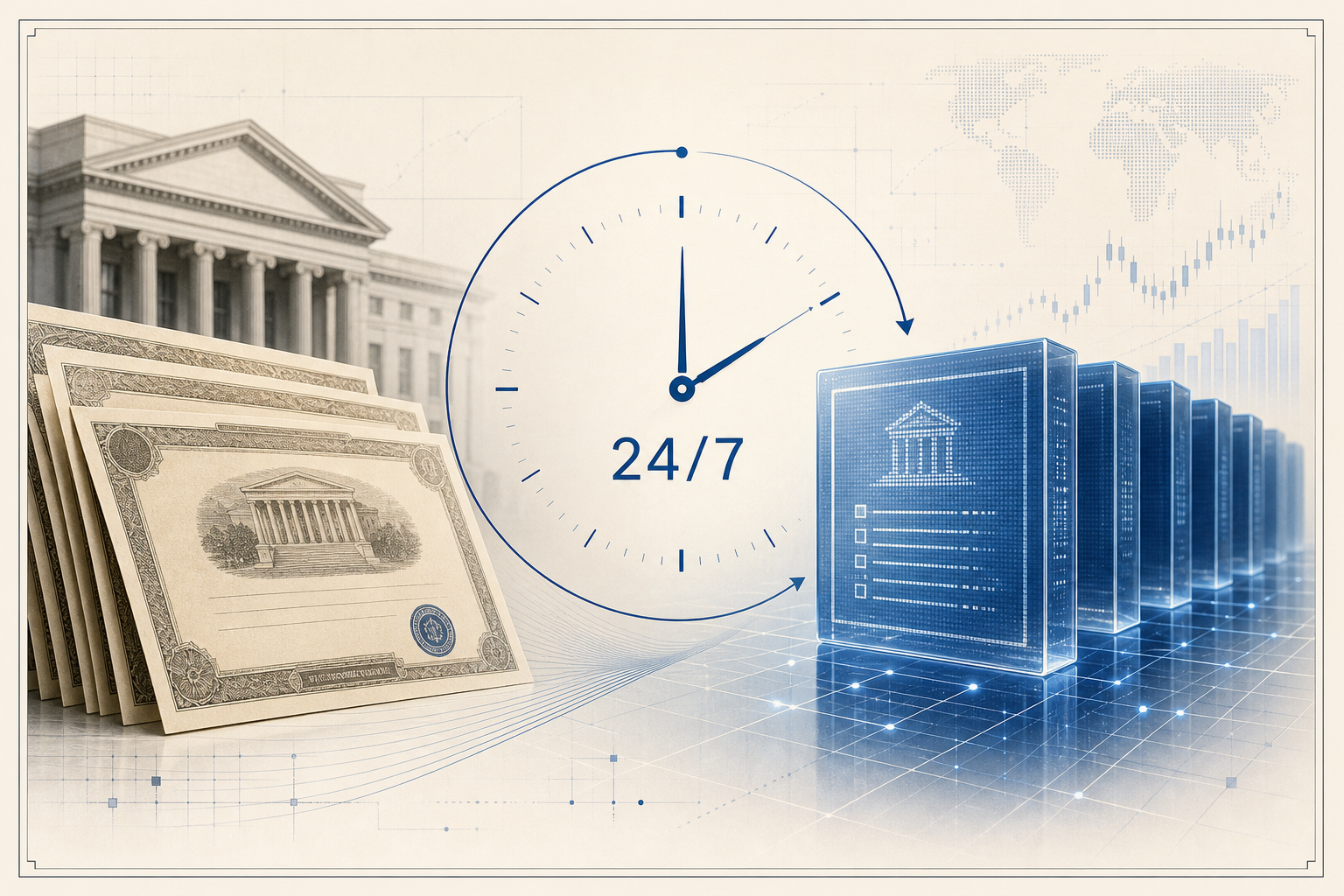
BNY is laying out one of the clearest institutional blueprints yet for making U.S. Treasury activity behave more like an always-on digital market. The immediate catalyst was an after-hours trade tied to stablecoin reserve management, but the broader significance is bigger: one of the world’s largest custody banks is now explicitly working on the operating model required to keep Treasury-related settlement moving beyond the traditional end of the U.S. trading day. If that effort holds, tokenized cash and tokenized government debt start to look less like parallel experiments and more like pieces of the same market infrastructure stack.
The bank’s latest step was a secondary-market Treasury transaction executed after the main Fedwire Securities window had already closed. According to the reporting on the transaction, the trade was connected to reserve assets for Ripple’s RLUSD stablecoin and OpenEden’s USDO product, with Tradeweb handling execution and BNY settling the cash side shortly afterward through existing rails. The securities themselves were not tokenized in that test, which is an important distinction. What changed was the workflow around them: the exercise showed that a bank can keep reserve-management activity moving after the legacy Treasury transfer cutoff, even when the underlying bond infrastructure still follows fixed market hours.
That gap is becoming harder for institutions to ignore. Stablecoins trade continuously, tokenized Treasury funds can be minted and redeemed across longer time zones, and large treasury desks increasingly want liquidity operations to extend into Asian and European hours. But the reserve assets behind many of those products remain constrained by weekday settlement windows and market close conventions. When inflows, redemptions or collateral calls arrive outside those hours, managers can face timing mismatches between the digital asset liability and the underlying government debt portfolio. BNY’s push is effectively an attempt to compress that mismatch and reduce the amount of dead time built into reserve operations.
The move is also consistent with how BNY has been expanding its digital-asset role over the past year. In April 2025, the bank said it was extending its Digital Asset Platform to deliver both on-chain and off-chain data across blockchain networks, with BlackRock’s BUIDL fund as the first client for the new data-on-chain capability. That product was not a Treasury settlement rail by itself, but it showed where BNY is aiming: deeper servicing infrastructure around tokenized funds, stronger transparency tooling, and a larger role across the lifecycle of on-chain financial assets rather than simple safekeeping alone.
Its relationships with the issuers involved in the latest Treasury workflow reinforce that direction. Ripple announced in July 2025 that it had selected BNY as the primary custodian for RLUSD reserves, pairing stablecoin reserve custody with transaction banking support. OpenEden, meanwhile, named BNY affiliates in August 2025 as investment manager and primary custodian for the underlying assets of its tokenized U.S. Treasury bills fund, TBILL. Taken together, those mandates put BNY in a position that few banks currently occupy: it sits across stablecoin reserves, tokenized Treasury fund servicing, custody, and the operational cash layer that links digital issuance to traditional securities markets.
That combination matters because the next phase of tokenization is less about proving that a fund share or Treasury claim can exist onchain and more about making the surrounding market machinery work at institutional scale. Execution, custody, cash movement, transfer windows, collateral management and reporting all have to line up if tokenized products are going to absorb larger balances from issuers, asset managers and treasury teams. A bank that can help synchronize those layers may become more strategically valuable than any single token standard or distribution venue. BNY’s latest test suggests that incumbents are no longer treating this as a distant product exercise; they are starting to rewire operational bottlenecks inside the settlement chain.
There are still hard limits. Fedwire’s timetable remains a real constraint for conventional Treasury transfers, and private blockchain pilots do not by themselves create legal finality across the full public-market stack. Extending settlement coverage across more of the Asian, European and U.S. day is not the same thing as creating a truly continuous Treasury market. Institutions will still need clarity on how tokenized positions reconcile with off-chain books and records, what happens across weekends and holidays, and how liquidity providers price risk when the cash and security legs operate on different clocks. Those issues are operational, regulatory and market-structure questions all at once.
Still, the signal from this episode is strong. When a custody bank of BNY’s size starts testing tokenized Treasury workflows and after-hours reserve trades, the conversation shifts from whether RWA infrastructure is real to which parts of the legacy post-trade stack break first under always-on demand. That is why this development qualifies as more than a niche stablecoin story. It points to the emerging shape of a Treasury market in which custody banks, tokenized fund issuers and digital-dollar operators are all being forced to solve for time-zone friction, settlement lag and reserve mobility at the same time.