Bank of Korea ties tokenized government bonds to its next phase of wholesale digital-money infrastructure
The Bank of Korea is moving tokenized sovereign debt closer to the center of its digital-currency strategy, linking bond issuance, collateral handling and deposit-token settlement to the next phase of Project Hangang. The message matters because it frames tokenized bonds as core market plumbing rather than a side experiment.
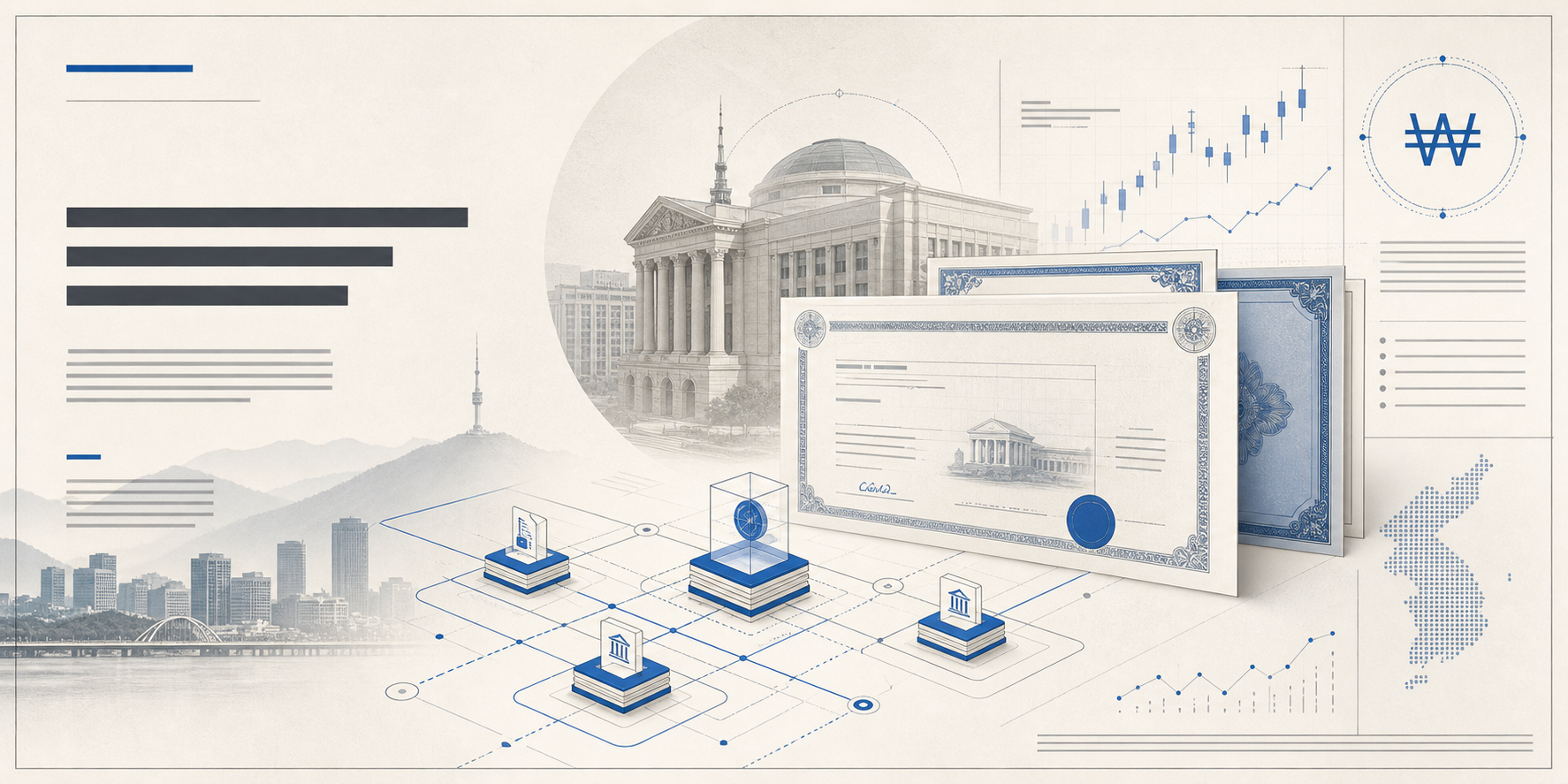
The Bank of Korea is putting tokenized government bonds much closer to the heart of its digital-money roadmap. During a panel at the ECB Forum on Central Banking in Sintra, Governor Hyun Song Shin described sovereign-bond tokenization as one of the clearest practical payoffs of moving financial assets onto a shared programmable ledger. His point was not that tokenization is a branding exercise for bond markets. It was that the mechanics around issuance, collateral verification, account crediting and transaction reversal become materially easier when the asset itself is natively digital and the settlement environment is designed around it.
That matters because sovereign debt sits at the core of modern financial plumbing. Government securities are not just investment products; they are reference collateral, liquidity buffers and a base layer for repo, money markets and central-bank operations. When a central bank starts describing tokenized government bonds as the “big prize,” it signals that official-sector thinking is moving past proofs of concept and toward the market segments that actually anchor the financial system. The Bank of Korea is effectively arguing that tokenization has to prove itself where operational complexity and collateral intensity are highest, not only where pilot programs are easiest to run.
The central bank’s own digital-currency program shows why that framing matters. On its public CBDC information page, the Bank of Korea says Project Hangang is testing a wholesale-style digital-currency network built around institution-only central bank money, bank-issued deposit tokens and other tokenized payment instruments that can interact with connected external systems. The stated purpose is to examine how distributed-ledger and tokenization features can support real payment and financial services in live conditions, rather than as a purely theoretical sandbox. Shin’s latest comments push that architecture a step further by explicitly connecting it to tokenized government debt and a unified ledger that could host central-bank money, commercial-bank liabilities and securities together.
The timing is also notable because the tokenized bond market has grown large enough to make the policy conversation concrete. RWA.xyz currently shows more than $31 billion in onchain real-world assets when stablecoins and cash-like instruments are included, with U.S. Treasury exposure still representing the single largest segment. In practice, that means regulators and central banks no longer have to debate tokenized fixed income as a fringe concept. They can look at an existing market structure, examine how onchain collateral moves, and decide which elements deserve to be folded into supervised payment and settlement rails.
The efficiency case for bond tokenization is straightforward. In today’s market structure, post-trade workflows around securities transfers, collateral substitution, settlement matching and reconciliation still involve multiple systems, intermediaries and timing gaps. A tokenized sovereign bond sitting on the same ledger as settlement cash or deposit tokens reduces the number of handoffs required to confirm ownership, move value and enforce timing conditions. That does not remove legal, governance or interoperability problems, but it does shift the debate toward implementation details instead of basic feasibility.
There is also a policy advantage in the way the Bank of Korea is sequencing the idea. Rather than starting from a retail-CBDC narrative, Project Hangang has focused on institution-grade rails and tokenized deposits. That approach is closer to how capital markets actually function. Wholesale collateral and interbank settlement are where the benefits of atomic settlement, programmable transfers and common data models can compound most quickly. If tokenized government bonds join that stack, the result would be a more coherent digital balance-sheet environment in which securities, reserve-linked money and deposit claims can be handled with fewer reconciliation breaks.
None of this guarantees immediate production deployment. A unified ledger for sovereign debt and tokenized money raises familiar issues around legal finality, privacy, operating standards, cybersecurity and cross-platform connectivity. It also forces hard questions about whether the ledger should be run by the central bank, banks, market infrastructures or some hybrid governance model. But Shin’s remarks are important precisely because they place those questions in an institutional context. The discussion is no longer whether tokenized bonds are imaginable; it is how a central bank would want them to coexist with regulated money and existing market infrastructure.
For the broader RWA market, that is the real signal. The next phase of tokenization will be shaped less by isolated product launches and more by whether core public institutions are willing to rework the settlement stack around digital representations of cash and collateral. By explicitly pairing tokenized government bonds with wholesale digital currency and deposit tokens, the Bank of Korea has outlined a model in which onchain finance is not a parallel system at the edge of markets. It is a candidate architecture for the market’s most foundational assets.