Aave is packaging stablecoin yield as embedded infrastructure for fintech distribution
Aave Labs has opened Stable Vaults to external builders, giving wallets, exchanges and payment apps a way to offer stablecoin earnings behind a familiar product surface. The launch matters because it turns DeFi yield into middleware that can be wrapped, permissioned and priced like a consumer-finance feature.
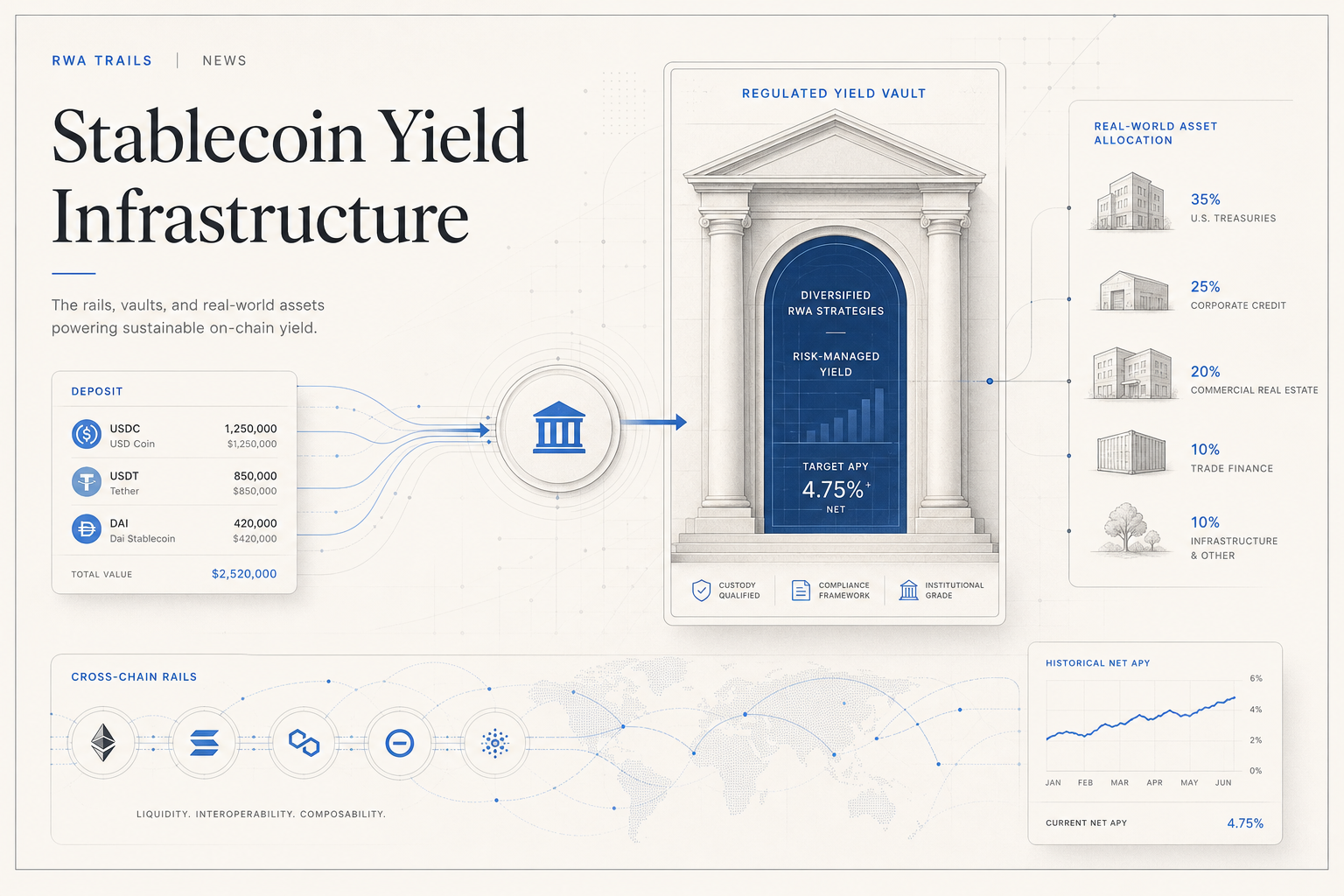
Aave Labs is pushing deeper into financial infrastructure with the launch of Stable Vaults, a product designed to let fintech platforms offer stablecoin earnings without asking users to operate like crypto-native lenders. The strategic shift is important for the RWA and stablecoin market because it reframes yield not as a destination product, but as an embedded capability that can sit behind wallets, exchanges, neobanks and payment applications. Instead of pushing end users into a separate DeFi workflow, Aave is offering businesses a way to keep the customer relationship, brand experience and account logic on their own front end while the yield engine runs underneath.
What makes the launch notable is the way Aave is trying to smooth one of the hardest product problems in onchain savings: variable returns. Aave’s public materials describe Stable Vaults as a stable-rate layer on top of fluctuating market yields. In practice, that means a platform can present users with a predictable earning rate while the vault handles liquidity management, accounting and yield allocation behind the scenes. The operator decides who can access the vault, what rate different users receive and how economics are shared back to the business. That is a more institution-friendly framing than the usual DeFi interface, where rates move constantly and user outcomes depend on how actively someone monitors the market.
The documentation also suggests Aave is thinking like an infrastructure provider rather than a single consumer app. Stable Vaults are described as supporting stablecoin deposits directly inside third-party products, with continuously compounding balances, permissioned access controls and the ability to assign different rates by customer segment, campaign or loyalty tier. Aave’s landing page further emphasizes multi-asset deposits and withdrawals, cross-chain operations and capital deployment across multiple chains and lending markets. That bundle matters because the biggest friction in bringing onchain yield into mainstream apps is rarely smart-contract access alone; it is operational complexity around treasury routing, liquidity fragmentation, reconciliation and product presentation.
Aave’s own blog indicates the system already underpins the company’s mobile savings app, which gives the launch more credibility than a concept-stage framework. The same materials say the stack can be extended across Aave v3, the coming Aave v4 architecture, sGHO and other yield venues, and that Chainlink CCIP can be used to support cross-chain functionality in production deployments. Taken together, those details point to a deliberate effort to turn Aave from a destination lending protocol into a backend layer that other financial products can integrate. For RWA-adjacent builders, that matters because distribution often determines adoption more than raw yield does. Stablecoin products gain reach when they are inserted into existing payment or treasury flows instead of asking users to seek them out.
The competitive backdrop is just as important. Stablecoin balances are becoming more useful in payments, remittances and digital treasury operations, but idle balances create pressure to add an earnings feature. Once that feature becomes common, the market starts to favor providers that can offer reliable integration, transparent controls and a less volatile customer experience. Aave is entering that race at a moment when embedded yield has moved from niche DeFi experimentation toward a broader financial-product category. By positioning Stable Vaults as infrastructure for businesses instead of a retail-only vault product, Aave is effectively arguing that the next wave of stablecoin adoption will be won inside distribution channels that already have users and compliance processes, not only inside standalone crypto apps.
That thesis has real implications for tokenized finance. In RWA markets, a large part of the value proposition is not simply token issuance, but packaging traditional financial outcomes in a form that can move through internet-native rails. Stable Vaults do not tokenize a treasury bill or private-credit instrument directly, yet they push in the same direction by turning yield-bearing stablecoin balances into a more legible financial primitive. If a fintech can offer a predictable earning account on top of blockchain-based assets, the gap between crypto infrastructure and consumer-finance UX narrows materially. That makes stablecoins more competitive as a cash-management layer and opens another route for onchain yield products to reach users who may never interact with a protocol directly.
There are still constraints to watch. A stable advertised rate depends on the operator’s risk controls, treasury management and the spread between what underlying strategies earn and what the frontend product promises to depositors. Cross-chain routing, permissioning and supported-asset redemption also introduce operational dependencies that need to work cleanly at scale. And for consumer-facing platforms, regulatory treatment of yield-bearing stablecoin products remains highly jurisdiction-specific. None of those issues disappear because the integration is cleaner. But the launch does show how mature DeFi stacks are being repackaged into more controlled, product-ready components that resemble financial middleware rather than experimental protocols.
The bigger takeaway is that Aave is betting distribution is now the key battleground. Stablecoins have already proven they can move value quickly and globally. The next contest is over who supplies the account layer, yield layer and product layer that make those balances useful inside ordinary financial software. Stable Vaults are Aave’s attempt to capture that layer by offering a prebuilt system for embedding earnings into existing apps. If the model works, it could become an important bridge between DeFi liquidity and the more structured, permissioned experience that mainstream fintech platforms need before they put onchain yield in front of everyday users.